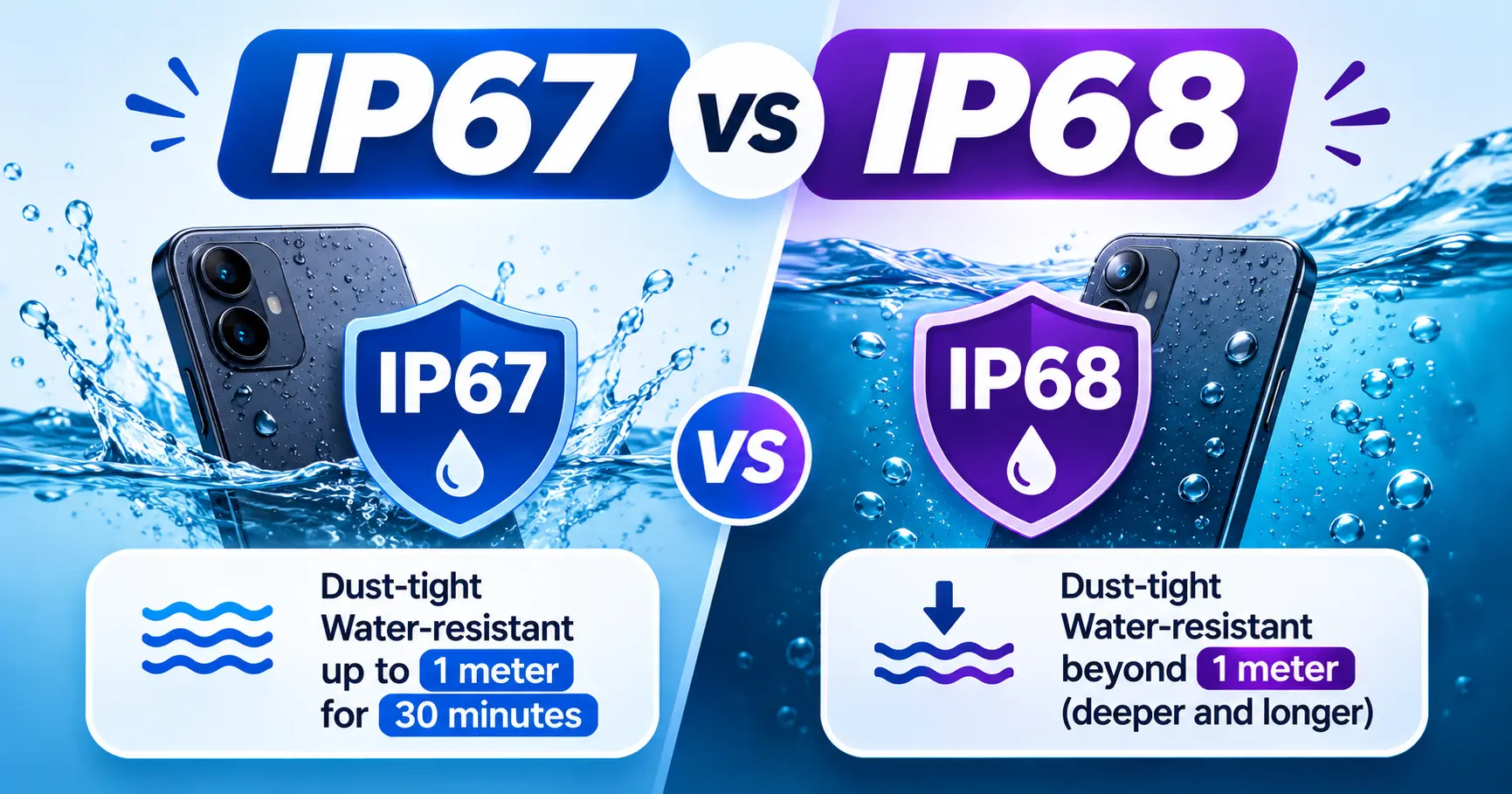
IP67 means a device can go 1 meter deep in fresh water for 30 minutes under IEC 60529 test conditions. IP68 means the device passed a stricter, manufacturer-defined immersion test that must beat IP67. Both share identical dust protection. Neither rating is permanent. Seals break down with time and damage. And neither one stops water from getting trapped inside your speaker grill.
You pick up your phone after a splash. The sound is muffled. The box said IP68. So why does the speaker sound like it is playing from underwater?
Billions of phones now carry an IP rating. Most people assume a higher number means their phone is fully safe from water. The truth is a bit more complicated. IP67 and IP68 are both water resistance ratings, but they do not protect every part of your phone the same way.
This guide explains the IP rating system, what each number actually means, how the two ratings compare, which phones carry which rating, and what an IP rating cannot do for your speaker.
What Does IP67 vs IP68 Actually Mean?
IP stands for Ingress Protection. It is a rating system defined by the International Electrotechnical Commission, or IEC, under a standard called IEC 60529. This standard is also recognized in the United States as ANSI/IEC 60529-2020.
The rating has two digits. Each digit measures a different kind of protection.

What Does the “6” Mean in IP67 and IP68?
The first digit measures protection against solid particles like dust, sand, and debris. The number goes from 0 to 6. A score of 6 is the best possible. It means the device is completely dust-tight. No particle of any size gets through.
Both IP67 and IP68 carry a 6 as their first digit. There is zero difference in dust protection between them. If you work in a dusty environment, both ratings give you the same level of safety.
What Does the “7” vs “8” Mean?
The second digit measures water ingress protection. This is where the two ratings split.
A 7 means the device can survive being submerged in 1 meter of still, fresh water for 30 minutes. This is a fixed number. Every device labeled IP67 water resistance was tested under those exact conditions.
An 8 means the device passed a harder immersion test. The IEC 60529 standard only requires that the test conditions must be tougher than IP67. The manufacturer and a certified testing lab like TÜV Rheinland or UL then agree on the specific depth and time together. Those agreed numbers must exceed the IP67 test.
This is the detail most people miss. IP67 is a fixed specification. IP68 is a customizable one. That difference matters more than it sounds.
IP67 vs IP68: Side-by-Side Comparison
| Feature | IP67 | IP68 |
| Dust protection | Fully dust-tight (6) | Fully dust-tight (6) |
| Water test depth | 1 meter | Manufacturer-defined, must exceed 1m |
| Water test duration | 30 minutes | Manufacturer-defined, must exceed IP67 |
| Standard type | Fixed (IEC 60529) | Customizable, must beat IP67 |
| Saltwater protection | No | No |
| Rating is permanent | No | No |
| Example phones | iPhone SE, iPhone XR, Samsung Galaxy A35 | iPhone 16 Pro, Samsung Galaxy S25, Google Pixel 9 |
| Real depth examples | 1m for 30 minutes | Apple: 6m / Samsung: 1.5m (both still count as IP68) |
The last row surprises most people. The iPhone 16 Pro and the Samsung Galaxy S25 are both labeled IP68. But Apple tests to 6 meters while Samsung tests to 1.5 meters. Same label, very different water protection in practice.
Is IP68 Better Than IP67?
For deeper or longer water exposure, IP68 is stronger. For everyday accidents, the gap is small.
IP67 water resistance handles rain, splashes, and short drops in sinks or puddles. That covers most real-world accidents. IP68 water resistance becomes worth the extra protection when your phone might go deeper or stay wet longer.
Use this table to match your situation to the right rating:
| Your situation | Which rating covers you? |
| Caught in rain | IP67 is enough |
| Dropped in a sink | IP67 is enough |
| Swimming in a pool | IP68 (check the manufacturer’s exact depth) |
| Beach or ocean use | IP68, though saltwater is not tested |
| Water sports like kayaking | IP68 with a manufacturer-confirmed depth spec |
| Dusty work environment | Either rating, both are fully dust-tight |
Since 2024, more mid-range phones have started shipping with IP68. The rating used to show up mostly on flagship models. That is changing, and phone buyers at lower price points now have more options with higher water protection.
Does IP67 or IP68 Actually Protect Your Speaker?
This is the question most IP guides skip entirely.
IP ratings test whether water causes harmful damage to the internal electronics inside a device. The test is not designed to check whether water gets into speaker grills.
Speaker grills are permeable by design. Sound waves must travel through them. You cannot fully seal a speaker grill and still produce audio. That physical reality means water can enter the grill even on a fully IP68-rated phone.
Water gets held against the mesh by surface tension. Those small droplets sit inside the grill and block the sound path. That is why a phone can pass an IP68 water resistance test and still produce muffled audio after getting wet.
Why Speaker Grills Still Trap Water on IP68 Phones
The IEC 60529 immersion test measures whether water reaches the internal circuit board and components. A tiny amount of water sitting on the speaker mesh surface does not trigger a test failure. The phone passes. The audio suffers.
A 2025 peer-reviewed study published in the journal e-Prime: Advances in Electrical Engineering, Electronics and Energy by researchers at Sungkyunkwan University found that the IEC 60529 standard is not aligned with real-world liquid protection for portable electronics. The standard was not built to test speaker performance after water contact.
This happens on IP67 phones, IP68 phones, and phones with no IP rating at all. The water-resistant seals around your phone protect the inside. The grill lets sound out, so water gets in.
What to Do When Water Gets Into Your Speaker
If your audio sounds muffled or quiet after getting wet, do not wait for it to dry on its own. That can take hours. And while you wait, leftover moisture can reach other parts of the phone.
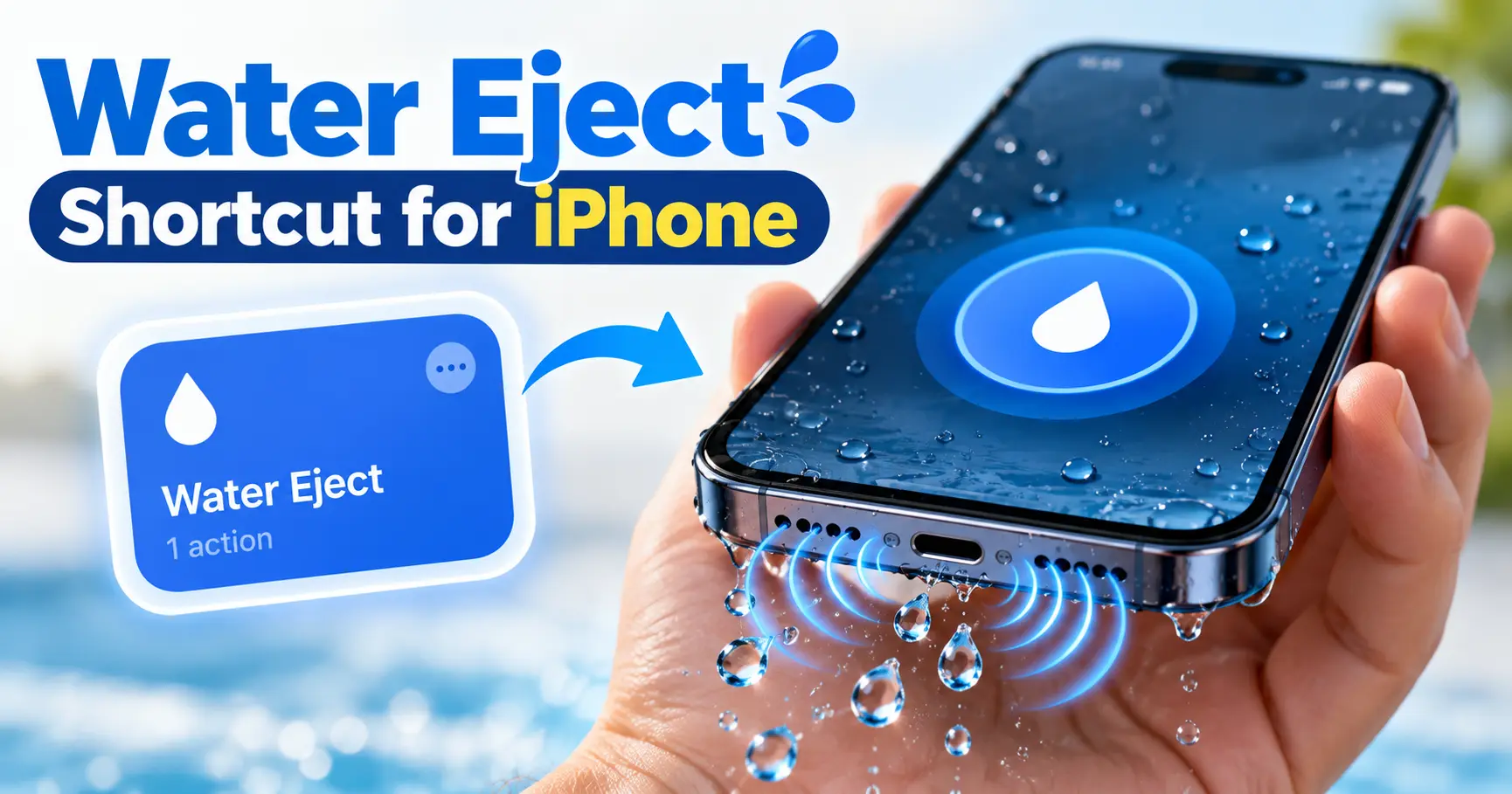
The quickest fix is to use an acoustic water ejection tone. Fix My Speaker plays a 165Hz tone that makes the speaker cone vibrate at high amplitude. That vibration breaks the water’s surface tension on the mesh and pushes the droplets out through the grill.
Tilt your phone with the speaker grill facing down while the tone plays. Set your volume to 100 percent. You will often see small water droplets appear on the outside of the grill within seconds. The tool runs entirely in your browser. No download needed.
Does Water Resistance Last Forever?
No. Water resistance is tested on new, factory-sealed devices under controlled lab conditions. It does not stay the same over time.

Here is what breaks down the water-resistant seals inside your phone:
- Drops. Even a small fall can loosen the adhesive that creates the sealed enclosure around ports and buttons, even if the screen does not crack.
- Screen repairs. A replacement done by a non-certified shop almost always breaks the factory seal.
- Heat and cold. Extreme temperatures expand and contract internal materials, wearing down gaskets over time.
- Saltwater and chlorine. Both corrode seals much faster than fresh water does.
The rating on the box describes a brand-new phone on its test day. By its second year of regular use, the real-world water protection of that same phone is likely lower.
Inside your phone, there is a small strip called a Liquid Contact Indicator, or LCI. It sits near the charging port or SIM tray. It starts white or silver. When it touches liquid, it turns red. That color change is permanent. Manufacturers check the LCI strip during warranty claims.
Does IP68 Cover Water Damage Under Warranty?
No. This catches a lot of people off guard.
Every major smartphone brand excludes water damage from its standard warranty, even on IP68 devices. The rating is a lab test result. It is not a coverage promise.
| Brand | What the warranty says |
| Apple | “This Warranty does not apply to damage caused by liquid contact.” |
| Samsung | “Product Warranty excludes sand, liquid, or food damage.” |
| “Do not expose your phone to liquids. Liquid damage voids warranty.” |
If your LCI strip has turned red, a water damage warranty claim will be denied. The strip does not reset. Your IP68 phone depth rating does not change that fact.
Which Phones Have IP67 and Which Have IP68?
Apple iPhones
| iPhone Models | IP Rating | Tested Depth |
| iPhone 7, 8, SE (2020/2022), XR, X | IP67 | 1 meter for 30 minutes |
| iPhone XS, 11 | IP68 | 2 meters for 30 minutes |
| iPhone 11 Pro, 12, 13, 14, 15, 16 | IP68 | 4 to 6 meters for 30 minutes |
If you own an older iPhone and your speaker sounds muffled after water contact, the Fix My iPhone Speaker Water Damage tool covers the specific steps for each model.
Samsung Galaxy
| Samsung Models | IP Rating | Tested Depth |
| Galaxy S7 through Galaxy S26 | IP68 | 1.5 meters for 30 minutes |
| Galaxy A35 | IP67 | 1 meter for 30 minutes |
| Galaxy A55 and newer A-series | IP68 | 1.5 meters for 30 minutes |
| Galaxy Z Fold series | IPX8 | No dust rating (folding hinge design) |
Google Pixel 9 and Pixel 9 Pro both carry IP68 ratings. The Samsung Galaxy Z Fold series carries an IPX8 rating, which means no dust protection rating is assigned due to the folding hinge.
If Your Speaker Sounds Muffled After Water Contact
An IP rating tells you a great deal about how well your phone handles water overall. What it does not tell you is that your speaker grill is fully protected. Speaker grills trap water even on IP68 phones. That is a physical reality no rating changes.
If you hear muffled audio, lower volume, or crackling after any water contact, run the water ejection tone right away. Set your volume to 100 percent, tilt the phone with the grill facing down, and let the acoustic vibration clear the grill. Most cases resolve in under two minutes.
Run the tone right now at the Fix My Speaker water ejection tool.
Frequently Asked Questions
What is the main difference between IP67 and IP68?
IP67 is tested at exactly 1 meter of fresh water for 30 minutes under a fixed IEC 60529 rule. IP68 is tested under conditions the manufacturer sets, as long as those conditions are stricter than IP67. Both give the same dust protection. The only difference is water submersion depth and duration.
Is IP68 fully waterproof?
No. IP68 means the device is water-resistant under specific lab conditions using fresh water. It does not mean the phone is waterproof in every situation. Saltwater, chlorine, and pressure exposure are not part of the IP68 test. The rating also fades with age and physical damage.
Can I swim with an IP68 phone?
With caution. An IP68 phone can handle brief, shallow submersion in still fresh water. Swimming creates moving water pressure and usually involves chlorinated or salted water, neither of which are covered by the test. Check the manufacturer’s exact tested depth before taking your phone into a pool or ocean.
Does IP67 protect against rain?
Yes. IP67 is more than enough for rain, splashes, and accidental water contact. The 1-meter for 30-minute submersion test far exceeds what rain exposure involves.
Why does my water-resistant phone have a muffled speaker after getting wet?
Speaker grills are permeable by design. Water enters the grill and is held against the mesh by surface tension. This blocks audio even on IP68 phones. The phone itself is undamaged, but the speaker temporarily sounds muffled. Using a 165Hz acoustic vibration water removal tone can dislodge the trapped water and restore clear sound.
Does water damage void my warranty even on an IP68 phone?
Yes. Apple, Samsung, and Google all state clearly in their warranty terms that liquid damage is not covered, regardless of IP rating. A tripped Liquid Contact Indicator inside the device is used to identify and deny water damage claims.
What is the difference between IP67, IP68, and IP69K?
IP67 covers temporary submersion to 1 meter for 30 minutes. IP68 covers deeper, longer submersion as defined by the manufacturer. IP69K covers high-pressure, high-temperature water jets and is an industrial rating not found on most consumer phones. A device can carry more than one IP rating at the same time.